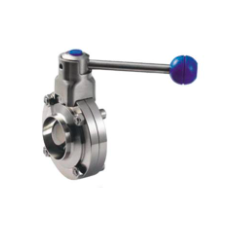
Body material: 304 or 316L stainless steel.
Sizes: from DN25 to DN150.
Connection: weld/weld. Optional male/weld.
Operation: manual.
Finish: bright polished.
Gasket: Silicone, EPDM, Viton, or NBR.
Standard: DIN, SMS, ISO.
Suitable for chemical, pharmaceutical, and food applications.
Valve with 3A, FDA, and CE certifications.
A butterfly valve is a device used to interrupt or regulate fluid flow by increasing or reducing the section via a disc. By decreasing the flow area, the pressure drop increases, reducing the flow. The butterfly valve has a low pressure drop when fully open. The relationship between the flow area and the butterfly’s rotation angle is non-linear. Butterfly valves are typically used in air ducts, liquid pipelines, and mechanical applications. Among the types of butterfly valves, double or triple offset butterfly valves provide less seat wear. This type of butterfly valve features an offset shaft (double) and a third eccentricity, if applicable, in the seat. The construction of a butterfly valve makes it an economical choice compared to other valve types. Additionally, a butterfly valve is more cost-effective when large sizes are required; due to its construction, a butterfly valve is easy to handle and install. A notable advantage of butterfly valves is the absence of cavities where solids could accumulate and impede valve maneuverability. Conversely, a disadvantage of a butterfly valve occurs under high working pressures.